4 day work weeks often means working four 10hr shifts. Same hours but less start and stop adds to productivity, and that extra day off during the work week means you can schedule things that day that otherwise would require time off during work hours. That extra day off really helps both employer and employee.
This paper studies the link between working hours and productivity using daily information on working hours and performance of a sample of call centre agents. We exploit variation in the number of hours worked by the same employee across days and weeks due to central scheduling, enabling us to estimate the effect of working hours on productivity. We find that as the number of hours worked increases, the average handling time for a call increases, meaning that agents become less productive. This result suggests that fatigue can play an important role, even in jobs with mostly part-time workers.
The full article is behind a paywall, but the discussion paper is available in full here.
Another paper suggests that, while same-day performance can sometimes increase with number of hours, next-day performance suffers. And, more importantly, routinely working shifts that are longer than 8 hours reduces productivity over time:
To start, we elucidate the tension between a widely held assumption grounded in the ideal worker norm that working long hours boosts performance and recovery research suggesting the opposite. Our findings reveal that, although working a long day is associated with a same-day performance boost, working long hours hinders overnight recovery by reducing sleep, hindering next-day performance. Our results also cautiously suggest that regularly working longer than 8-h days results in fatigue and a lack of resilience, making it difficult for employees to sustain high levels of performance over time.
That’s not what they mean by the 4 day work week. I’ve had the 4 10 hour days and friending in the work you’re but very productive with a day that long. It’s hard to be in the zone thinking hard for 10 hours.


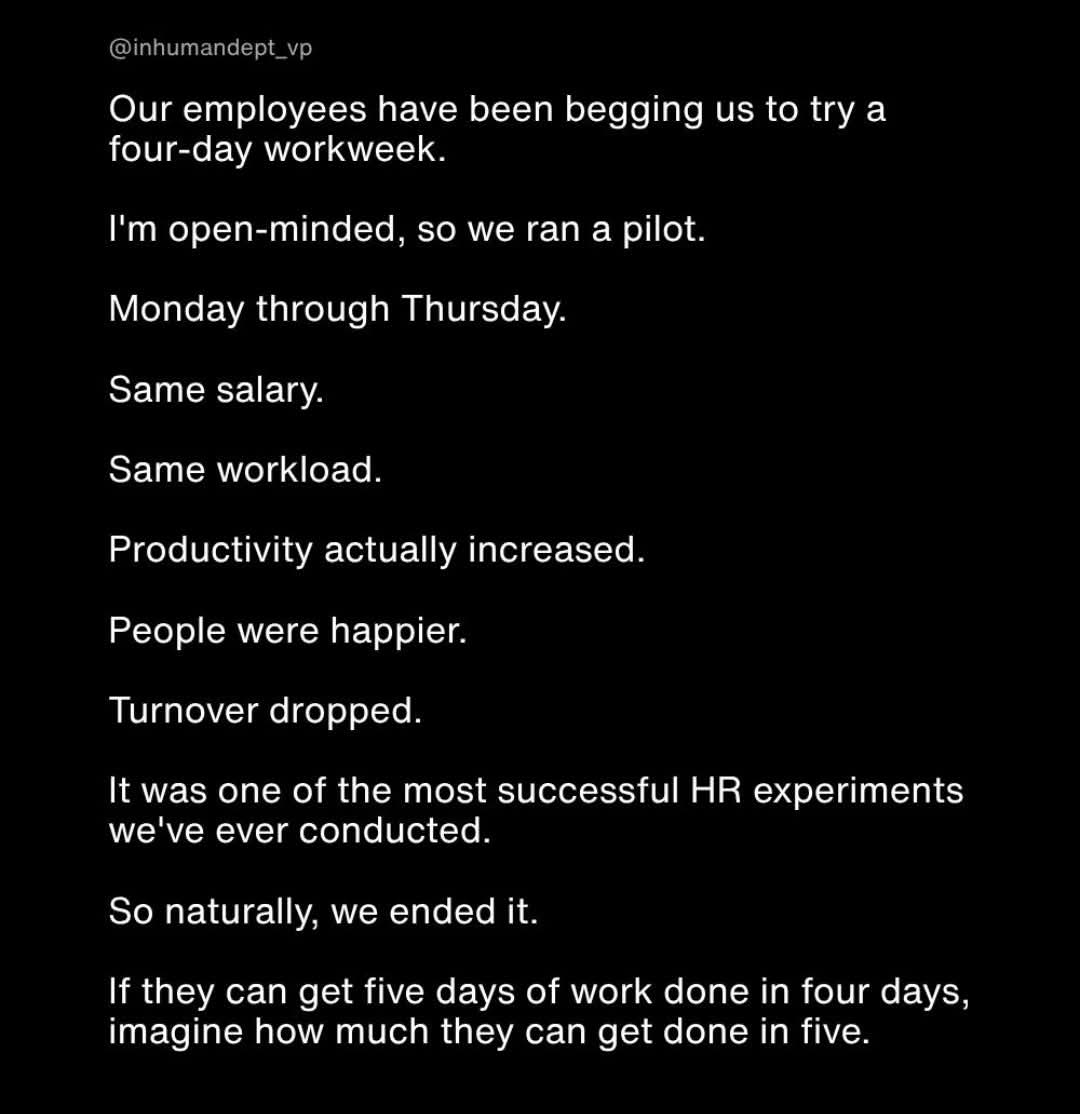
If productivity increased then you had some slackers before
4 day work weeks often means working four 10hr shifts. Same hours but less start and stop adds to productivity, and that extra day off during the work week means you can schedule things that day that otherwise would require time off during work hours. That extra day off really helps both employer and employee.
4 tens is so much better than 5 eights.
Going to need a citation for that, because that is not what the research I’ve seen suggests.
From this paper:
The full article is behind a paywall, but the discussion paper is available in full here.
Another paper suggests that, while same-day performance can sometimes increase with number of hours, next-day performance suffers. And, more importantly, routinely working shifts that are longer than 8 hours reduces productivity over time:
I have consistently seen the four-day workweek defined as 32 hours per week (4x8hr), not 4x10hrs.
I’ve tried that before. I get less done on a 10 hour shift than I do in 8. Have to wake up too early and go home too late. It’s torturous.
Now a 32 hour week for the same pay is peak. Doesn’t even need to be three continuous days off. A weekend and a Wednesday is good enough.
That’s why we need to end the push for the 4-day week.
And start the push for the 32-hour week.
That’s not what they mean by the 4 day work week. I’ve had the 4 10 hour days and friending in the work you’re but very productive with a day that long. It’s hard to be in the zone thinking hard for 10 hours.
Yeah because people are more well rested with 3 days off. So they can focus better during the workday.
Times are different I guess. I was always bagged after weekends heading back to work on Monday.
Productivity also increases when people are allowed to work from home. Turns out hostile work environments are not conducive to productivity.