

I proposed this project to improve on Radicle’s p2p model by using Tor for universal, straightforward seeding of git repos.
Original discussion thread - https://bounties.monero.social/posts/207/
One of the project’s git repos linked in that thread - https://radicle.network/nodes/iris.radicle.network/rad:z2ydYmUCJvDfNFTVTpEbQmm55EPt1/history
Project website - https://cradicle.xyz/
The dev who took the project also expanded it into a project to reimplement Radicle in C.
Since I’m not a coder and I don’t have any git repos of my own, I can only test from the viewpoint of an average layman using the GUI app to seed repos.
It’s impossible for me to properly gauge how the project is progressing without engagement from coders who try using it for their git repos.
If the project doesn’t currently interest you, your suggestions on how to start getting users on board would also be welcome.
Edit - bear in mind that because decentralized discussion platforms like this are currently quite broken, there are comments showing up in the thread when I’m not signed in that don’t show up for me when I’m signed in. Here’s a screenshot of all the comments showing up for me right now where I’m signed in and able to reply, as of UNIX time 1779670288
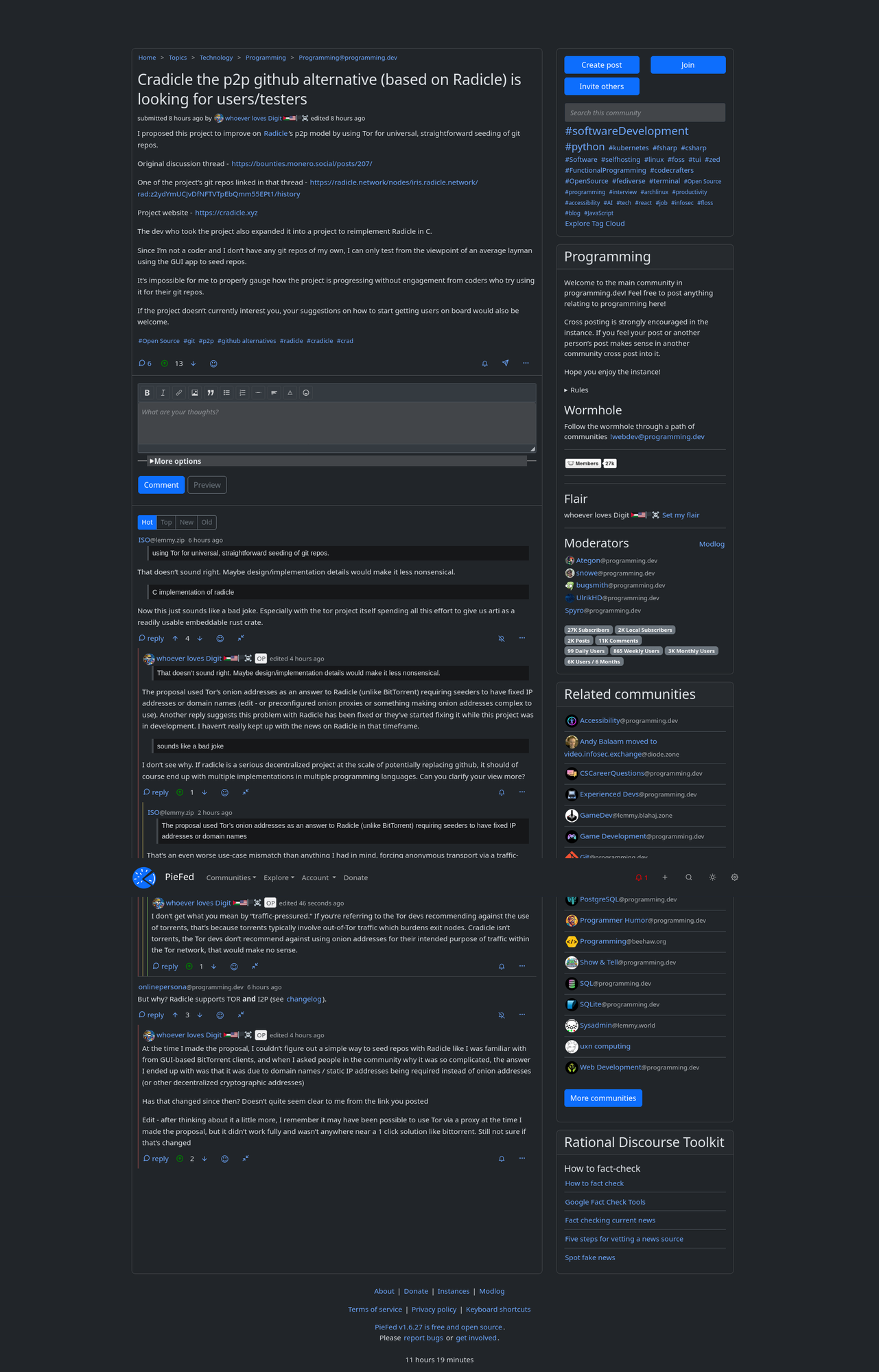
I’d encourage discussion of this project moreso on nostr (equally broken but my preferred platform) or the discussion thread linked above (seemingly more functional)
So I gave the actual code a one minute look (literally).
Picked
src/radicle/util.c, since that was the last file touched.The level of defensive programming doesn’t look that good (and I’m trying to be nice here).
Here is an example, and note that I didn’t do C in a while:
#include <stdio.h>
#include <string.h>

void rad_rstrip_nl(char* str) {
    int len_str = strlen(str);
    if (str[len_str-1]=='\n') {
      str[len_str-1] = 0;
    }
}

bool rad_get_input (char* str, size_t bufsiz) {
    if (!fgets(str,bufsiz,stdin)) return false;
    rad_rstrip_nl(str);
    return true;
}

int main() {
  char a[] = {0,0,0,0};
  bool i = rad_get_input(a, 4);
  printf("%lu\n", strlen(a));
  rad_rstrip_nl(a);
  return i;
}
The two functions above
main()are copy-pasted from that file.Let’s zoom in:
int len_str = strlen(str);
if (str[len_str-1]=='\n') {
Here we’re accessing
str[len_str-1]without checkinglen_strfirst.But you might be thinking, maybe
len_strcan’t be zero!Let’s compile first with the AddressSanitizer enabled:
# compile
% gcc -Wall -fsanitize=address t.c -o t
Now let’s see how easily we can have fun:
 % echo -n '\0' | ./t
=================================================================
==2949689==ERROR: AddressSanitizer: stack-buffer-underflow on address 0x7ba827af001f at pc 0x56032434d259 bp 0x7fff1d199010 sp 0x7fff1d199000
READ of size 1 at 0x7ba827af001f thread T0
    #0 0x56032434d258 in rad_rstrip_nl (/tmp/t+0x1258) (BuildId: 1ee68e4d67960002de80ae290c8811c63f94aa51)
    #1 0x56032434d311 in rad_get_input (/tmp/t+0x1311) (BuildId: 1ee68e4d67960002de80ae290c8811c63f94aa51)
    #2 0x56032434d3e4 in main (/tmp/t+0x13e4) (BuildId: 1ee68e4d67960002de80ae290c8811c63f94aa51)
    #3 0x7fa82a227740  (/usr/lib/libc.so.6+0x27740) (BuildId: 020d6f7c33b2413f4fe10814c4729dce1387f049)
    #4 0x7fa82a227878 in __libc_start_main (/usr/lib/libc.so.6+0x27878) (BuildId: 020d6f7c33b2413f4fe10814c4729dce1387f049)
    #5 0x56032434d124 in _start (/tmp/t+0x1124) (BuildId: 1ee68e4d67960002de80ae290c8811c63f94aa51)
(The rest of
AddressSanitizeroutput omitted.)Another function from the same file:
char* rad_strcpy (char* out, const char* inp, int from, int len) {
    const char* inp_shifted = inp+from;
    int len_inp_shifted = strlen(inp_shifted);
    if (len <= len_inp_shifted) {
	memcpy(out,inp,len);
	out[len] = 0;
    }
    else {
	memcpy(out,inp,len_inp_shifted);
	out[len_inp_shifted] = 0;
    }
    return out;
}
Here,
inpis shifted beforeinplength is checked, which doesn’t look safe. But my one minute is up, so I didn’t dive into the function callers.Pretending C is a good choice in 2026, then not being extra vigilant with defensive programming, is not a good look. I remember myself being more vigilant in my wrappers even when I was a beginner.
This is made worse by the developer repeating literal memes like:
Maybe such an enlightened developer should know that you can bootstrap
rustcfrommrustcusing GCC.Awesome, I think you’re the first person to give Cradicle a bit of a code audit. Thank you. I’ll check your feedback with a more C-focused programming community to see what others think before passing it onto the dev.
This reminds me of another reason I thought the dev made an interesting choice with C: by using C, we might attract “red team” volunteers to provide scrutiny.