
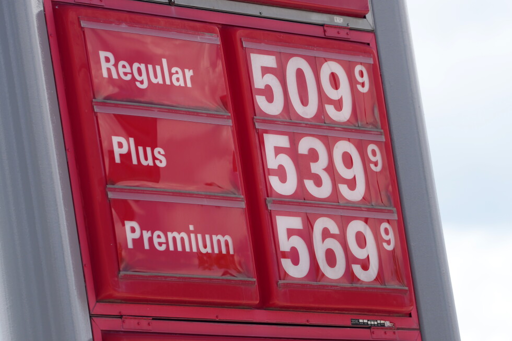
WASHINGTON (AP) — U.S. consumer confidence declined slightly this month as gas prices stayed high and inflation remained elevated, a sharp contrast to soaring stock prices hover near record levels.
The Conference Board’s consumer confidence index slipped 0.7 points to 93.1 in May, the first decline after three months of gains. The measure hasn’t fallen as much this year as other gauges of consumer attitudes, but it has been stuck at a low level since the pandemic. Before COVID-19, it regularly reached 130.
A separate gauge of consumer sentiment released last week by the University of Michigan fell to a record low this month. Soaring gas and food costs have worsened inflation that is outpacing the average growth in paychecks, reducing most Americans’ purchasing power. Americans have soured on President Trump’s economic policies, polls show, potentially creating problems for Republicans heading into the midterm elections.
How is the stock market increasing if people aren’t buying the things that those companies produce? I know the answer is because the stock market is based entirely on feelings and doesn’t have any basis in reality. But I still want to ask the question.
Stock price is dependent on the average trade price, so technically you could just drive up a stock if you had limitless funds.
But the fun stuff is market cap (the “value”) of a company only takes the current price into account, because how else could it work?
So recent trades drive up the value of a stock that most people bought when it was cheaper, doesn’t mean a billion or trillion or whatever dollars went into it recently. Only means there are more buyers than sellers and the price has gone up.
It also means that you can’t actually sell the entire company worth of stock and get the value listed as its market cap. There wouldn’t be demand for it and it would plummet hard.
All the money that’s accumulating in the hands of the ultra rich has to go somewhere, and that somewhere is investment assets and investment assets are chosen based on going up in price and said going up in price needs not be for any reason other than that money is going into those assets in the expectation that the prices will go up (i.e. it’s just a feedback loop of price increases attracting more buyers which in turn makes prices go up).
It’s one big Ponzi Scheme and it will keep on going until there is no more money entering the scheme.
As it so happens we’re living a long period of the wealth that was accumulated across society for decades being sucked out from the hands of the many into the hands of the few, and said few then keep putting more money into investment assets (what would be the point of buying yet another yacht) which is what keeps the whole price goes up because people buy -> people buy because price goes up loop going in so many asset categories, from housing and stocks to ultra speculative stuff like crypto.
This shit will only stop when it crashes and the longer it keeps going the harder it will crash.
Tbf a lot of it is ordinary people with their 401ks or ETF purchases. Like a very big percentage. That creates the baseline demand, which means the line is always going up when things are good.
Then the ultra rich and the gamblers make bets on which companies beat that constantly rising line.
advertising bot networks
The stock market looks like gambling but it’s actually fraud.
I feel like it’s a spectrum that’s entirely dependent on how much wealth and connections you start with.
The stock market isn’t really dependant on companies actually producing stuff. The expectation of them producing stuff is enough. Which is why this whole AI-circlejerk exists for example.
It is all insider trading and companines funding each other with the same non-existant money.
I mean, that’s phrased really about as well as anyone could phrase it. You could also say that there are two Americas: the 1% and everyone else. The stock market is a measure of how the 1% are doing. When Bondi said “the Dow is over 50000!” in that senate hearing, she was basically just saying, “the rich people think this administration is great, so you should too.”
2 factors:
Every salary person has 15% of their income go to the stock market for their 401k.
Most things are staples that people have to buy. Companies increase their prices and consumers don’t have a choice. The increased price means increased earnings.
Currently the rest of the stock market is essentially held up by 7 companies.
https://oriongemini.substack.com/p/the-number-is-going-up
And the 401k contributions are the significant factor here. Until people start pulling their 401ks out, this wont stop.
For tech, it goes up because expectations on higher profits. Datacenters and the dystopia is driving right now. Memory sticks are through the roof because datacenters buys it all. Same with drives and gpus.
It takes years to build the dystopia so lots of profits on that. And then profits on watching people in real time and selling their data.